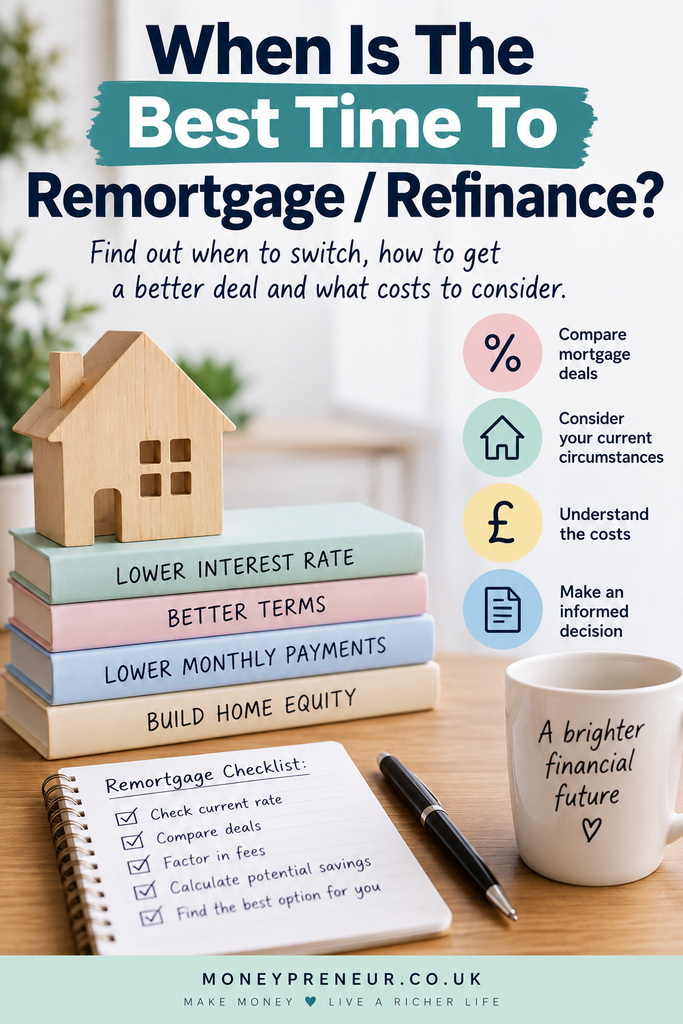
Discover the Best Time To Remortgage, when to start looking for a new deal and the costs to consider before switching.

Disclaimer: This article is for general information only and does not constitute financial advice. Mortgage products, rates, fees and eligibility vary between borrowers and lenders. Consider speaking to an FCA-authorised mortgage adviser if you need advice based on your specific circumstances.
Knowing when to change your mortgage can potentially save you a considerable amount of money, but timing matters. The Best Time To Remortgage is often several months before your current deal ends, giving you enough time to compare mortgage deals without automatically slipping onto your lender’s standard variable rate.
However, reaching the end of a fixed-rate period isn’t the only reason to consider remortgaging. A change in mortgage interest rates, your property value, credit score or financial situation could make a new deal attractive sooner.
On the other hand, early repayment charges, lender fees and other additional costs can mean switching early doesn’t always make financial sense.
So, when is the right time to start looking?
What Does Remortgaging Mean?
Remortgaging means replacing your existing mortgage with a new mortgage deal, usually without moving home.
You might switch to a new lender, or your current lender might offer you a different mortgage product. Staying with the same lender and moving onto another of its products is normally known as a product transfer rather than a remortgage.
In the United States, changing an existing home loan is usually referred to as refinancing. You may therefore come across terms such as refinance rates, conventional loan, loan program, adjustable-rate mortgage, closing costs and appraisal fee when reading US financial websites.
The basic principle is similar: you replace or change your current loan in the hope of obtaining better terms, reducing costs or achieving another financial goal.
When Is The Best Time To Remortgage?
For many UK homeowners, a sensible time to investigate the wider market is around six months before the end of the current mortgage deal.
MoneyHelper recommends setting a reminder to start shopping around at least six months before a fixed or discounted deal reverts to the lender’s standard variable rate (SVR).¹
Starting early doesn’t necessarily mean you need to switch immediately. It simply gives you time to research mortgage offers, speak to a mortgage broker if necessary and understand what your options are.
If you leave everything until the end of your term, you could have much less time to compare mortgage lenders and find the most competitive rate available to you.
Why Six Months Before Your Mortgage Ends Can Be A Good Time
There are several advantages to looking early.
Firstly, some mortgage offers remain valid for several months, potentially allowing you to secure a new rate before your existing deal finishes.
Secondly, you have more time to compare the overall cost of different mortgage deals rather than concentrating solely on the headline interest rate.
Finally, starting early provides some breathing room if the remortgage process takes longer than expected because of affordability checks, valuation issues or legal work.
MoneyHelper says introductory mortgage deals commonly last between two and five years. When they finish, borrowers will generally move onto their lender’s standard variable rate unless they arrange another deal.¹
That makes your mortgage end date one of the most important dates to put in your financial calendar.
Set A Remortgage Reminder
A simple solution is to create a remortgage reminder for six months before your fixed-rate period ends.
At that point, check:
- your outstanding mortgage balance
- your current rate
- when your existing deal ends
- whether early repayment charges still apply
- your property’s approximate value
- your current loan term
- your credit rating
- the mortgage payments you can comfortably afford
- current mortgage rates across the wider market.
You don’t necessarily need to take action immediately. Think of this as your mortgage review date.
What Happens When Your Fixed Rate Ends?
A fixed rate gives you predictable monthly payments for an agreed period. For example, with a two-year fixed-rate mortgage, your interest rate generally remains unchanged for those two years.
At the end of the fixed-rate period, you will normally move onto the lender’s standard variable rate unless you arrange another deal. MoneyHelper notes that an SVR is often higher, meaning your monthly mortgage payment could increase.²
This is one of the biggest reasons homeowners review their mortgage before their current deal expires.
Suppose, for example, you could move from your lender’s SVR to a lower rate elsewhere. Depending on your mortgage balance, fees and remaining term, paying less interest could result in useful monthly savings.
However, a lower interest rate doesn’t automatically mean a better deal.
You need to look at the total cost.
When Mortgage Interest Rates Have Fallen
A significant rate decrease can be another reason to investigate remortgaging.
Perhaps you fixed your mortgage when higher interest rates were common, but market rates have subsequently fallen. You may discover that a substantially better rate is now available.
The important question isn’t simply:
“Can I get a lower rate?”
Instead ask:
“Will changing mortgages leave me financially better off after every fee and charge is included?”
Imagine switching saves £150 per month but costs £4,000 in early repayment charges and fees.
Your monthly payments would be lower, but it would take more than two years of £150 monthly savings to recover £4,000 of switching costs.
If you were planning to move home in a year, switching might make little financial sense.
If you expected to remain in the property for considerably longer, the calculation could look very different.
Should You Wait For The Bank Of England Base Rate To Fall?
Trying to predict the perfect moment to remortgage can be difficult.
The Bank of England base rate influences borrowing costs across the economy, but mortgage interest rates aren’t determined by Bank Rate alone. The Bank of England itself explains that the rates banks charge depend on other factors too, including lending risk and the length of a loan.³
As of the Bank of England’s most recently published decision before this article was prepared in September 2026, Bank Rate stood at 3.75%.⁴ Rates change, however, so always check the latest information rather than relying on this figure when making a mortgage decision.
If markets expect rates to fall, new fixed mortgage rates can sometimes change before the Bank of England actually reduces Bank Rate.
Similarly, waiting for another rate decrease doesn’t guarantee that the mortgage deal you want will become cheaper.
Instead of trying to predict the lowest available rate, it can be more useful to compare what’s available with your current circumstances and decide whether the numbers work for you.
When Your Credit Score Has Improved
Your credit score and wider credit history can play an important role in mortgage applications.
If your financial situation has improved considerably since you originally took out your mortgage, you may qualify for better terms than previously.
For example, perhaps you have:
- consistently made mortgage payments on time
- reduced outstanding credit cards
- paid down other debts
- increased your income
- built a longer history of responsible borrowing.
Remember that there isn’t one universal UK credit score used by every mortgage lender. Lenders use their own eligibility and affordability criteria alongside information from credit reference agencies.
Your debt-to-income ratio is another phrase you’ll frequently encounter on US refinancing websites. UK mortgage lenders don’t necessarily use this calculation in exactly the same way as US lenders, but your income, committed expenditure and existing debts can still influence affordability assessments.
Before applying, checking your credit reports for mistakes can therefore be worthwhile.
When Your Property Value Has Increased
A higher property value could potentially improve the mortgage deals available to you.
Why?
Mortgage lenders frequently price products according to loan-to-value (LTV) bands.
For example, imagine your home is worth £300,000 and your mortgage balance is £240,000. Your LTV would be 80%.
If your mortgage balance later falls to £210,000 while the property value rises to £350,000, your LTV becomes 60%.
A lower LTV may give you access to different mortgage deals and potentially a better rate, although eligibility and rates aren’t guaranteed.
This is why increases in home equity, combined with paying down the mortgage, can potentially create new remortgaging opportunities.
Should You Remortgage Early To Get A Better Rate?
You can remortgage before your existing deal finishes, but this is where you need to pay particularly close attention to early repayment charges.
The FCA explains that borrowers leaving a fixed or discounted deal early may have to pay an ERC. It is commonly calculated as a percentage of the remaining mortgage balance and may decrease as you approach the end of the deal.⁵
MoneyHelper says ERCs can sometimes be around 1% to 5% of the outstanding balance, although the exact terms depend on your mortgage.⁶
That can represent a lot of money, particularly on large mortgages.
For example, a hypothetical 3% ERC on a £250,000 outstanding mortgage would be:
£250,000 × 3% = £7,500
Even if another lender offers a much lower interest rate, you would need substantial savings to compensate for a £7,500 charge.
Check the terms of your existing deal carefully before switching.
Work Out The Break-Even Point
One of the best ways to decide whether switching early is worthwhile is to calculate approximately how long it will take to recover the cost.
Suppose:
Early repayment charge: £3,000
New mortgage/product fees: £1,000
Legal and other costs: £500
Total switching cost: £4,500
And suppose your new mortgage reduces your monthly payments by £200.
Your approximate break-even period would be:
£4,500 ÷ £200 = 22.5 months
In this simplified example, it would take just under two years for the monthly savings to recover the upfront costs.
However, comparing monthly payments alone can be misleading. A mortgage with a longer term can reduce the monthly payment while increasing the amount of interest you ultimately repay.
The FCA specifically warns that extending the mortgage term can mean paying more interest overall.⁷
Always consider the total cost, not just the new monthly payment.
Don’t Compare Mortgage Rates Alone
Finding the best rate doesn’t necessarily mean you’ve found the best deal.
Suppose Mortgage A offers the lowest available rate but comes with a £1,999 product fee.
Mortgage B has a slightly higher rate but no product fee.
Which is cheaper?
It depends partly on your mortgage balance and how long you will keep the product.
The lowest rate could make sense for some borrowers, particularly those with large mortgages, while the fee-free option could potentially cost less for someone with a smaller mortgage.
This is why comparing the overall cost during the period you expect to keep the mortgage is so important.
What Does It Cost To Remortgage?
Remortgaging isn’t necessarily free.
Potential refinancing costs or remortgage costs can include:
Product or arrangement fees: Charged by some mortgage lenders for setting up a particular deal.
Early repayment charges: Potentially payable for leaving your current deal early.
Exit fee: Your existing lender may charge an administration fee when the mortgage is closed.
Valuation costs: A new lender might require a valuation of the property.
Legal costs: Switching lenders can involve conveyancing or other legal work.
Mortgage broker fees: Some brokers charge their customers directly, while others receive commission from lenders.
MoneyHelper says changing mortgage can cost £1,000 or more, depending on the mortgage and circumstances.⁸
Some lenders offer free valuations, free legal work or cashback, which can reduce the additional costs.
Again, calculate the overall cost rather than choosing a mortgage based purely on the interest rate.
What Are Closing Costs And Appraisal Fees?
If you’re reading about refinancing rather than remortgaging, you may see terminology aimed at US homeowners.
Closing costs are expenses associated with completing a US mortgage or refinance.
An appraisal fee is generally the cost of having the property’s value professionally assessed for the lender.
You might also encounter terms such as conventional loan, adjustable-rate mortgage and loan program.
These aren’t necessarily equivalent to UK mortgage terminology, so be careful when applying US refinancing advice to a UK mortgage.
For UK borrowers, terms such as arrangement fee, product fee, valuation fee, legal costs, exit fee and early repayment charge are generally more relevant.
Remortgaging To Fund Home Improvements
Some homeowners remortgage because they want to borrow additional funds, perhaps to pay for substantial home improvements.
If your property has increased in value or you’ve built significant home equity, increasing your mortgage could provide access to additional borrowing.
But turning additional spending into mortgage debt shouldn’t be taken lightly.
A mortgage is secured against your home, and spreading borrowing over many years can mean paying a significant amount of interest.
You should compare the total cost with alternative ways of financing the project and consider what would happen if mortgage rates or your financial circumstances changed.
Remortgaging To Consolidate Credit Cards And Other Debts
Another reason people consider borrowing more against their property is to repay higher-interest debts such as loans or credit cards.
A mortgage may have a lower interest rate than unsecured borrowing, but that doesn’t automatically make consolidation cheaper or safer.
Moving short-term debt onto a long mortgage term can mean paying interest for much longer. You are also converting unsecured borrowing into debt secured against your home.
The FCA has highlighted risks around additional mortgage borrowing used for debt consolidation, particularly where borrowers already have high levels of debt.⁹
This is an area where regulated financial or debt advice can be particularly valuable.
Product Transfer Or Remortgage?
You don’t always have to move to a new lender to get a new deal.
Your current lender might offer you a product transfer.
This can sometimes be a simpler option because you’re staying with the same mortgage provider. Depending on the lender and circumstances, the process may involve fewer checks and less legal work than moving elsewhere.
But convenience doesn’t necessarily mean it offers the best deal.
Compare your lender’s product transfer options with the wider market before deciding.
A mortgage broker may be able to help compare suitable deals from multiple mortgage lenders, although some products may only be available directly from lenders.
Should You Use A Mortgage Broker?
A mortgage broker can be particularly useful when your circumstances aren’t straightforward.
For example, you might benefit from advice if you’re:
- self-employed
- carrying substantial existing debt
- dealing with unusual income
- remortgaging a non-standard property
- looking for additional borrowing
- approaching retirement
- considering a lifetime mortgage
- unsure which type of mortgage is suitable.
The Financial Conduct Authority regulates mortgage advice in the UK, and you can check whether a firm or adviser is authorised through the FCA Register.
The FCA says many borrowers are expected to continue benefiting from regulated mortgage advice even following changes designed to make remortgaging easier.¹⁰
What About A Lifetime Mortgage?
A lifetime mortgage is very different from an ordinary repayment mortgage or standard residential remortgage.
It is a form of equity release typically aimed at older homeowners. Interest can roll up over time, potentially reducing the value of the estate significantly.
If you’re considering equity release, don’t treat it as simply another mortgage deal. It deserves separate research and specialist advice.
When Might Remortgaging Not Be Worthwhile?
Even when a better rate is available, remortgaging isn’t always the best option.
It might be less attractive if:
You have a large early repayment charge.
The financial benefits of the lower rate might not compensate for leaving your current deal early.
Your mortgage balance is small.
Potential interest savings might be outweighed by lender fees, legal costs and other additional costs.
Your financial circumstances have deteriorated.
A lower income, higher debts or weaker credit rating could reduce the mortgage offers available.
You’re planning to move soon.
Paying substantial fees for a new mortgage deal that you’ll only keep briefly might not make financial sense.
Your current deal is already competitive.
Changing mortgages simply because new products have appeared doesn’t mean you’ll save money.
Extending the mortgage term creates a higher overall cost.
A lower monthly mortgage payment can look attractive while hiding the fact that you’ll be paying interest for many additional years.
Is It Worth Remortgaging For A Small Rate Reduction?
Potentially.
A relatively small reduction in interest can make a meaningful difference on a large mortgage, whereas the same rate reduction on a small balance may produce much smaller savings.
For example, the impact of reducing a mortgage rate by 0.25 percentage points will be very different on a £500,000 balance compared with a £50,000 balance.
The remaining mortgage term also matters.
Instead of asking whether a particular rate decrease is “big enough”, calculate the potential savings based on your outstanding balance and compare them against every cost of switching.
What If Interest Rates Are Rising?
Higher rates create a different decision.
If your current fixed deal still has several months remaining, you might investigate whether it’s possible to secure a mortgage offer for your next deal ahead of time.
That doesn’t mean you should automatically lock into the first rate you see.
Mortgage rates can move in either direction, and nobody can know with certainty what market conditions will look like several months ahead.
Compare the security of fixing your payments against the possibility that market rates could change.
Your own ability to cope with potentially higher mortgage payments should play an important role in the decision.
What If Interest Rates Are Falling?
Falling rates can make borrowers reluctant to commit to a new fixed mortgage because they hope an even lower rate will appear next month.
The problem is that rates could move the other way.
Instead of attempting to perfectly time the market, consider whether the available deal works for your budget and financial objectives.
You can also check whether a lender allows you to move to a cheaper product before completion if its rates fall after you’ve secured your mortgage offer. Policies vary between lenders, so ask before assuming this is possible.
Should You Choose A Two-Year Or Five-Year Fixed Rate?
There isn’t a universal answer.
A two-year fixed-rate mortgage provides certainty for a shorter period and allows you to review your mortgage sooner. However, you could face another set of remortgaging costs relatively quickly.
A five-year fix provides longer payment certainty but could leave you tied into the mortgage for longer, potentially with early repayment charges if your circumstances change.
Your choice could depend on:
- the difference between available rates
- product and lender fees
- how long you expect to remain in your home
- your future plans
- how much payment certainty you value
- your attitude towards changing mortgage interest rates
- the flexibility offered by the mortgage.
Rather than trying to predict which option will turn out cheapest, compare what each would mean for your household under different scenarios.
What About The Average SVR?
You may see articles quoting an average SVR across mortgage lenders.
This can provide a general picture of the mortgage market, but your lender’s actual SVR is what matters to you.
Likewise, average current mortgage rates don’t tell you which rate you personally qualify for.
The rate available to you could depend on your loan-to-value, credit history, income, mortgage size, property and other lender criteria.
Personalised mortgage offers are therefore more useful than market averages when making an informed decision.
UK Remortgaging Vs US Refinancing
Although remortgaging and refinancing broadly describe replacing or restructuring home finance, there are differences between the UK and US mortgage markets.
US borrowers researching refinance rates might encounter conventional loans, closing costs, appraisal fees and adjustable-rate mortgages.
US home purchases also commonly involve long-term fixed mortgages where the interest rate can remain fixed for decades.
In Britain, shorter fixed-rate periods are common, meaning borrowers may revisit their mortgage several times during the full repayment term.
The principles of comparing rates, fees, monthly payments and total costs apply in both countries, but the products and regulations differ considerably.
A Simple Remortgage Checklist
Around six months before your existing deal ends, consider working through the following:
- Check your current mortgage. Find your balance, current rate, remaining term and the exact date your deal finishes.
- Check for early repayment charges. Find out when they reduce or disappear.
- Estimate your property value. This will help you calculate your approximate loan-to-value.
- Review your finances. Look at income, debts, regular commitments and credit reports.
- Ask your current lender about a product transfer. Find out what new rate and terms it can offer.
- Compare the wider market. Look at other mortgage lenders or consider using a mortgage broker.
- Include every fee. Factor in product fees, valuation costs, legal costs, broker charges and any exit fee.
- Compare total costs. Don’t judge deals solely by their headline interest rates or monthly payments.
- Consider your future plans. Moving house, changing jobs, retiring or making major home improvements could affect which mortgage is suitable.
- Make an informed decision. Choose based on your specific circumstances rather than trying to guess exactly where interest rates will go next.
So, When Is The Best Time To Remortgage?
For many homeowners, the Best Time To Remortgage is around the end of an existing fixed or discounted mortgage period, with the research process beginning roughly six months beforehand.
That gives you time to compare your current lender with the wider market, investigate a product transfer and potentially arrange a new mortgage before being moved onto an SVR.
But there are situations where reviewing your mortgage earlier could be worthwhile.
A substantially lower interest rate, increased property value, improved financial situation or need to restructure your borrowing might justify looking sooner.
The deciding factor should be whether the new mortgage produces genuine financial benefits after early repayment charges, lender fees, legal costs and other refinancing costs are included.
Finding a better rate is only part of the calculation.
Finding a mortgage that suits your finances, future plans and tolerance for changing interest rates is what really matters.
Sources
- MoneyHelper – Remortgaging to get the best deal. MoneyHelper recommends reviewing your mortgage and shopping around up to six months before your current fixed deal ends.
- MoneyHelper – Understanding mortgages and interest rates. Guidance on fixed-rate mortgages and standard variable rates.
- Bank of England – What are interest rates? Explanation of Bank Rate and the factors influencing borrowing rates.
- Bank of England – Interest rates and Bank Rate: our latest decision. Bank Rate was held at 3.75% at the July 2026 meeting; the next decision was scheduled for 17 September 2026.
- Financial Conduct Authority – Support available for mortgages as interest rates rise. Information about early repayment charges.
- MoneyHelper – If you’re worried about rising mortgages. Guidance on ERCs and switching mortgage deals early.
- Financial Conduct Authority – MCOB 11.9. FCA guidance notes that extending a mortgage term can result in paying more interest overall.
- MoneyHelper – Mortgage fees and costs. Information about remortgaging, valuation and other mortgage costs.
- Financial Conduct Authority – Second charge mortgages: improving outcomes for consumers. FCA findings relating to additional borrowing and debt consolidation.
- Financial Conduct Authority – FCA helps people navigate their financial lives with simplified mortgage rules. Details of changes designed to make remortgaging easier.
If you liked this post “When Is The Best Time To Remortgage / Refinance?” share it with your friends on social media and Pin it for later…